Eating seasonally includes eggs. Our hens have all stopped laying while they moult. We have heritage breeds at the moment. They do what they need to do to stay healthy.That means taking a break from laying eggs. Just like us hens are born with their allotted number of eggs. Once they're laid there is no more. Those hens bred for the egg laying industries don't stop laying until they have laid their allotted eggs which is why the industry pack them off at around 18 months of age.
During the spring and summer we enjoy an abundance of eggs and it gives us a diverse array of opportunities when it comes to cooking and baking. But now the eggs are few and far between and we need to adjust our menus.
Here's a recipe for an egg free date loaf that we will enjoy over the coming months.
Date and Walnut Loaf ( from an old book Quick and Easy Vegetarian)
Ingredients
1 cup chopped dates
1 cup boiling water
2 tablespoons golden syrup ( I use honey)
1/2 cup brown sugar
1 teaspoon baking soda
1 teaspoon vanilla essence (I use extract)
2 cups wholemeal flour
1/2 cup chopped walnuts
Place dates in bowl and add boiling water.Mix in honey (or golden syrup) brown sugar, baking soda, and vanilla. Sprinkle in the wholemeal flour and add walnuts. Mix until combined. Place mixture in a greased loaf tin and bake at 180degrees for 45 mins or until loaf springs back when lightly touched. Leave in tin for 10 mins before turning onto a cake rack to cool.

Showing posts with label seasonal produce. Show all posts
Showing posts with label seasonal produce. Show all posts
Friday, May 6, 2016

Thursday, March 17, 2016
Farm Tour
On Tuesday some "earthy coasties " took a tour of our Farm to learn what they could about growing food for their local community.
 They first took a look at our propagation house. This is where it all begins. All our seedlings are propagated here on the farm. It's pivotal to the whole CSA enterprise.
 Showing how we do it here on the farm. Everyone does it differently and this is how it works for us. Seedlings germinated into punnets, potted up into small pots and put out into a hardening off area prior to planting out.
 A rooster in with 10 hens inside our chook domes keeps the hens happy. Less fighting among the hens.
 One of our hens showing of her latest hairdo.
 While Mark talks to our visitors I make good use of the time collecting snails. The small amount of rain had the snails moving around. Great protein for the hens.
 Explaining the system. Chooks do the cultivating and then are moved onto the next bed leaving a bed free of bugs and weeds and fertilized ready for new seedlings.

Our dear old dog Aggie following us around while we conduct the tour.
 Drops of rain on the chilli.
 Explaining the planting regime. Fast growing plants like this Tatsoi inter planted with slow growing plants. By the time the slower growing larger plants need the room the quicker growing plants have been harvested.
 Discussing the bed set aside for the attraction of beneficials. This is our pest control;.
Ten years ago we decided to set ourselves up as a model to showcase our small market garden To show people how to live sustainably, to grow food and sell the excess or like us start a CSA ( Community Supported Agriculture). We would like to see more market gardens started in and around towns and cities to feed the local community.


Ten years ago we decided to set ourselves up as a model to showcase our small market garden To show people how to live sustainably, to grow food and sell the excess or like us start a CSA ( Community Supported Agriculture). We would like to see more market gardens started in and around towns and cities to feed the local community.
Wednesday, January 6, 2016
Zucchini Soup
I don't usually like to eat soup during summer. It's something that I long for as the long hot summer draws to a close. But yesterday was cold and wet and as we have an abundance of zucchini I decided it was just right for dinner last night.
Cream of Zucchini Soup
Ingredients2 Tblspns. oil
1 tsp butter
1 onion roughly chopped
1 kg zucchini, trimmed and sliced
2 tblspns fresh oregano
2 1/2 cups stock
4 oz cheese
300mls cream
Method
Heat oil and butter in a large saucepan. Add onion and cook gently until softened but not brown
Add zucchini and oregano. Cook over a medium heat for 10 mins, stirring frequently.
Pour in stock and bring to the boil, stirring. lower the heat and simmer gently stirring occasionally for about 10 mins. Stir in cheese until melted.
Process the soup with food processor until smooth.
Add 2/3 cup cream and stir over low heat but not boiling. swirl in remaining cream and garnish with oregano and extra cheese.


And look who we rescued from the rain last night. The geese had wandered a little too far yesterday and this little one couldn't keep up so Mark picked her up and brought her inside. She was very chirpy this morning full of cheek so I put her back out with the others. I've kept them locked up in a smaller paddock today so they can't take her too far.
Rain is still falling and has delayed the harvest for today's CSA but it will get delivered, just a little later than usual.
Thursday, December 10, 2015
Weekly Meal Plan
We have been operating our CSA for 10 years now and over that time we have seen subscribers come and go, but on the whole our most loyal customers have been with us from day one. They are your typical foodie types and can manage to use up every morsel of produce we put in their box. They look in their box every week and think of what they can make for the week that best uses the produce and gives them a variety of meals throughout the week. It's about planning the weekly meals based on what's in the box.
Here's my weekly meal plan based on this week's box.....

Last night was our farm community weekly shared meal. I made this rice and vegie pie. Another member made a garden salad and another made a couscous salad. This served 6 adults with most vegetable ingredients sourced from individual CSA boxes.
Rice and Vegetable Pie
Ingredients
2 cups cooked brown rice (sometimes I use leftover rice ) cooked in stock
2 cups grated or finely chopped seasonal vegies. I always include mushrooms.
1 onion
Chopped parsley
4 eggs
1 cup grated cheese
2 tsp. curry powder
1 tsp. herbs of your choice.
Method
Combine all ingredients in a large bowl and mix thoroughly. Place in pie dish and top with extra cheese if you like. Bake in moderate oven for 45 mins. or until firm.
Can be served hot or cold. Great to take on picnics and such.
I used one of the zucchinis, tatsoi, eggs and herbs from the box plus carrot, onion and mushrooms from the fridge.
The other meals on my plan will use the remaining vegies from the box spread out over the week so nothing goes to waste.
Here's my weekly meal plan based on this week's box.....

Last night was our farm community weekly shared meal. I made this rice and vegie pie. Another member made a garden salad and another made a couscous salad. This served 6 adults with most vegetable ingredients sourced from individual CSA boxes.
Rice and Vegetable Pie
Ingredients
2 cups cooked brown rice (sometimes I use leftover rice ) cooked in stock
2 cups grated or finely chopped seasonal vegies. I always include mushrooms.
1 onion
Chopped parsley
4 eggs
1 cup grated cheese
2 tsp. curry powder
1 tsp. herbs of your choice.
Method
Combine all ingredients in a large bowl and mix thoroughly. Place in pie dish and top with extra cheese if you like. Bake in moderate oven for 45 mins. or until firm.
Can be served hot or cold. Great to take on picnics and such.
I used one of the zucchinis, tatsoi, eggs and herbs from the box plus carrot, onion and mushrooms from the fridge.
The other meals on my plan will use the remaining vegies from the box spread out over the week so nothing goes to waste.
Tuesday, December 8, 2015
Zucchini Cake
At this time of year it can be a challenge to use all the produce in the CSA box, with such an abundance ofsummer vegies. At the moment the boxes are recieving 3 or more zucchini each and what do you do with them all?
We eat as many as we can in as many ways as we can and at the moment it's probably three times a day. But for us there is always an excess even with the amount going into boxes for our subscribers.
We preserve them in mustard pickles which gives us a lovely condiment all year round.
And we make Zucchini chocolate cake which can be frozen thus preserving our zucchinis in a different way or eaten there and then....

Ingredients
1/2cup butter
1 1/2 cups sugar
2 eggs
1 tsp. vanilla
1/2 cup milk
4 Tblsp. cocoa
2 1/2 cups SR flour
1 tsp. bicarb
1/2 tsp. cinnamon
1/2 tsp. salt
2 cups shredded zucchini
Method
Cream butter and sugar
Beat in eggs
Add milk and vanilla and sifted dry ingredients
Stir in zucchini
Grease and flour a 23cm x 30cm tin ( I used a smaller ropund tin and a ring tin giving me two cakes. I found the lareger tin didn't cook evenly as it's such a moist cake).
Bake at 160 deg. C for 40 - 45 mins.
Friday, December 4, 2015
Summer CSA
Our summer CSA started this week. Good spring rains have meant that we are off to a flying start. We had a little scare a few weeks back with a hail storm that shredded the newly planted summer crops. But I was quick to give all the plants a tonic of seaweed which I believe gave them just the pick me up they needed after such a shock.
The lemon balm and lemon verbena make a beautiful drink. Leave a few leaves of each to steep in boiling water. Lovely to drink either hot or cold.
We have a few places left for our CSA this season. Please contact me via email if you would like to subscribe to receiving a beautifu box of lovely fresh produce each week for the next 3 months. Local area only.
Our workshops and courses have now been finalised. We have a Gift Voucher available for those of you who would like to give a gift of knowledge this Christmas.
It's wonderful to be back here in this space after such a long time. Our internet access was so poor for so long that I found the whole thing just too frustrating. But now our interent connection is much more reliable and I look forward to sharing with you the goings on of our little farm.
 |
| The cucumbers were the worst hit by the hail but have come back beautifully. |
 |
| Tomatoes growing around the edge of the mandala gardens. We grow Tommy toes and Romas as we find they are least affected by fruit fly |
 |
| Purple King beans growing in one of the mandala beds. We like to grow the purple variety as they are easier to see amongst the foliage making harvesting a little easier. They turn green once cooked. |
 |
| Potatoes growing in a mandala bed |
 |
| Long beds at the front of the mandala gardens. We use the pigs to cultivate these beds whereas the chickens cultivate the round beds. You can just see one of the chicken domes in the background. |
 |
| A herb posy was part of the box this week. For those of you not familiar with all the herbs I've taken a photo for you. |
We have a few places left for our CSA this season. Please contact me via email if you would like to subscribe to receiving a beautifu box of lovely fresh produce each week for the next 3 months. Local area only.
Our workshops and courses have now been finalised. We have a Gift Voucher available for those of you who would like to give a gift of knowledge this Christmas.
It's wonderful to be back here in this space after such a long time. Our internet access was so poor for so long that I found the whole thing just too frustrating. But now our interent connection is much more reliable and I look forward to sharing with you the goings on of our little farm.
Thursday, March 12, 2015
Autumn Harvest


Do you have a similar scene of abundance at your place....pumpkins everywhere?

We grew Queensland Blues, Golden nuggets from a pumpkin gifted to me from Melissa, and Hubbards squash grown locally here in the Hunter. Our area has previously been renowned for its pumpkin growing. Our local football team is called, and has always been called The Pumpkin Pickers. But the area doesn't grow pumpkins in the volume it once did. There has been a little bit of a resurgence when the local hay grower was approached to grow food again and he has set aside a small portion of his land for food, but really it's a pittance compared to the food that was once grown in this area. What a shame for a city that grew food for Sydney.We have great potential for once again growing large scale produce.
But anyway, here on our little farm we grew enough pumpkins for us and our CSA members to last for a while, at least until we all get sick of eating pumpkins, which brings me to asking you for a favour. Do you have a favourite pumpkin recipe apart from the usual, like soup, rissoto, scones,or pie that you would share with me, to pass onto my subscribers. If so maybe you could email me the recipe or attach a link to it in the comments. It would be very much appreciated. One of the biggest reasons for a CSA (Community Supported Agriculture) subscriber not to renew their subscription is because they can't handle the quantity of seasonal produce. For this reason I like to help them out with recipe ideas.
 |
| Cooking pumpkin in the solar oven |
Thanks for your help! And don't forget to leave a comment on my last post to go in the draw for a visit to the farm.
Monday, January 12, 2015
Slow Food
One of the things I learned in Italy (did I tell you we went to Italy last year?) was how to prepare and enjoy simple food. We stayed for a week with an exWWOOFer in Laverno, just south of Pisa. This is in Tuscany, where the climate is so very similar to ours, here in the Hunter. They grow olives, grapes, tomatoes, zucchini, cucumber and everything else that grows well here. But, unlike us they grow food everywhere. Looking out of a train window allowed us to see the lengths people will go to to grow themselves food. Small allotments, including a shed to stay in over the weekend, are prolific in Tuscany. They are all along the tracks, in small odd shaped areas between the tracks and a road and invariably have olives, kiwi fruit and grapes growing. Tuscany is renowned for it's olive oil. Some of the allotments are tiny, some are around an acre. Italians love their food. But not the highly processed, fast food that is so prevalent here in Australia. No, Italians love fresh seasonal,local produce.The only fast food outlets I saw were at railway stations and airports! I only saw one large shopping centre. There are mini markets in the cities but mainly people shop at markets that are set up within the city that change daily depending on vendor availability. All sorts of produce can be found at these markets along with clothing, furnishings, and bric a brac. There is bread, cheeses, fresh seafood, and fruit and vegies. Here's a little three wheeler van selling produce in Turin.

and a market in Venice...
.JPG)

.JPG)


Elizabetta showed us how much food meant to the Italians. It was all about choosing fresh local food, cooking it simply, with friends, a glass of beer close at hand, and savouring it, seated around a simply, but beautifully set table. Eating slowly with a glass of wine, talking and laughing. One night, after a day in Florence, with came home and found a friend of Elizabetta's was in her kitchen preparing some food for us. He had a fresh salad, to be eaten first. Followed by some lightly steamed vegies. As our contribution Elizabetta showed us how to make a simple pasta dish with broccoli, which had just come into season over there (Autumn). Start cooking the pasta and in the last 5 mins drop in broccoli. While that's cooking fry up garlic and onion in a lot of olive oil. Combine with cooked pasta and broccoli. Add more olive oil and serve. One of the most delicious meals ever. Simple and fast. Elizabetta said to use whatever seasonal produce is available for this dish so that's what I did for dinner last night. Overwhelmed with the amount of zucchini, beans and tomatoe we have at the moment I wanted to use up a lot of them. With some of the garlic and onion we have hanging on the verandah drying ....

and some of the excesses from the garden....
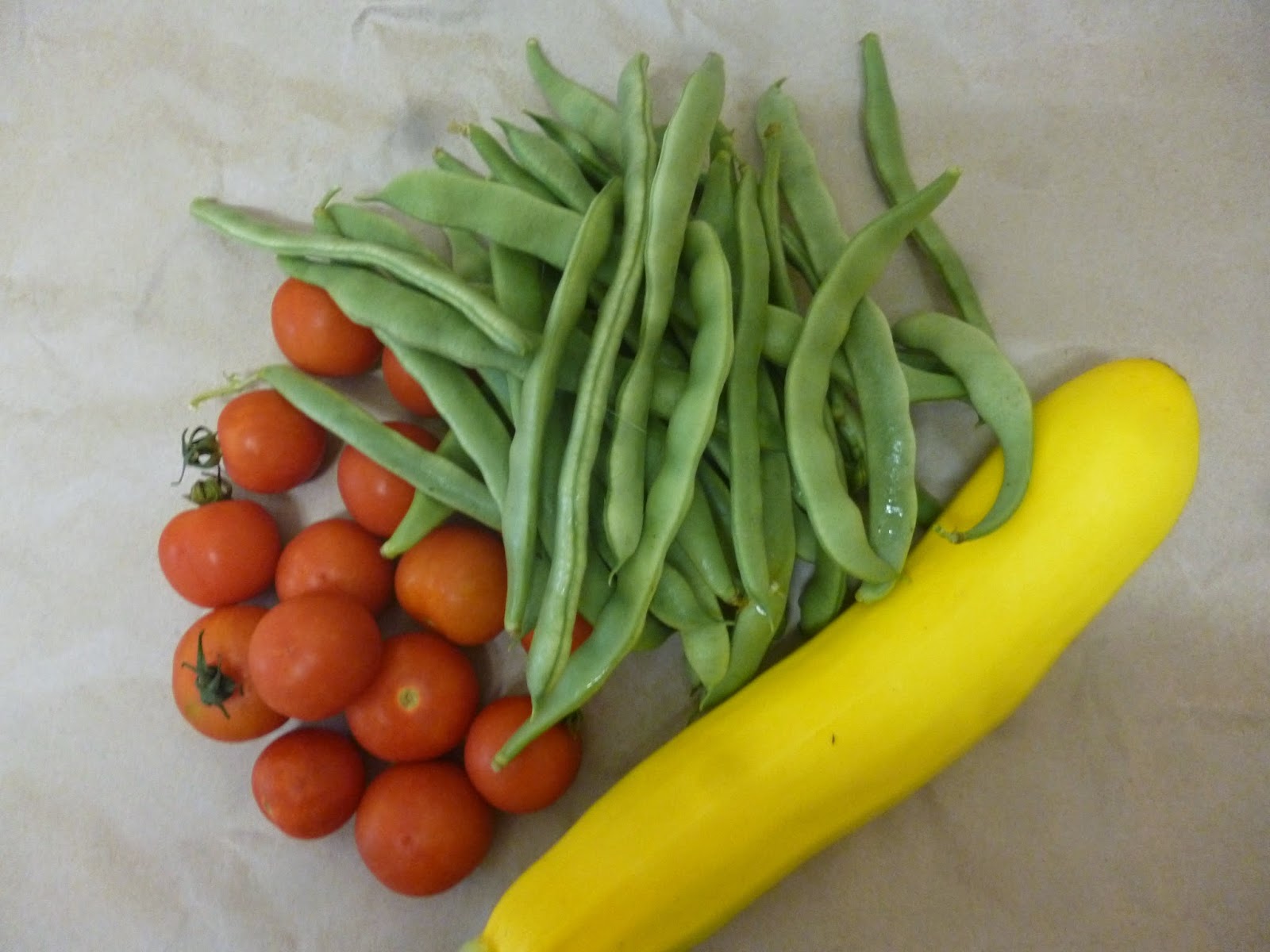
I made up a very simple pasta dish reminiscent of the broccoli pasta from Italy. I fried the onion and garlic, then added zucchini, and beans and lastly tomatoes. Serve with pasta with lots of olive oil and parmesan cheese. Delicious!!
There is lots we can learn from the Italians.
and a market in Venice...
Here's another market in Venice, floating this time..
I loved that I could walk to the markets everyday and buy anything I needed from an open air market. And I loved that I could go to a cafe and have an espresso and freshly baked pastry or a glass of wine or beer. I loved that I could go to the drinks cabinet in a cafe and take out a beer from alongside the fizzy drinks. I loved that we would be given some nibblies to have with our beer or wine, free of charge.
I loved that we could sit and play cards at the cafe while we drank our beer. (notice the cards don't have any numbers...very tricky!)
And when we got back to Elizabetta's (wwoofer) she knew that we would have been indulging with the local food and wine and she would say that we were going on a diet that night and would serve us up lightly steamed fresh vegies with a liberal amount of olive oil.
and some of the excesses from the garden....
I made up a very simple pasta dish reminiscent of the broccoli pasta from Italy. I fried the onion and garlic, then added zucchini, and beans and lastly tomatoes. Serve with pasta with lots of olive oil and parmesan cheese. Delicious!!
There is lots we can learn from the Italians.
Tuesday, September 30, 2014
Today In The Garden


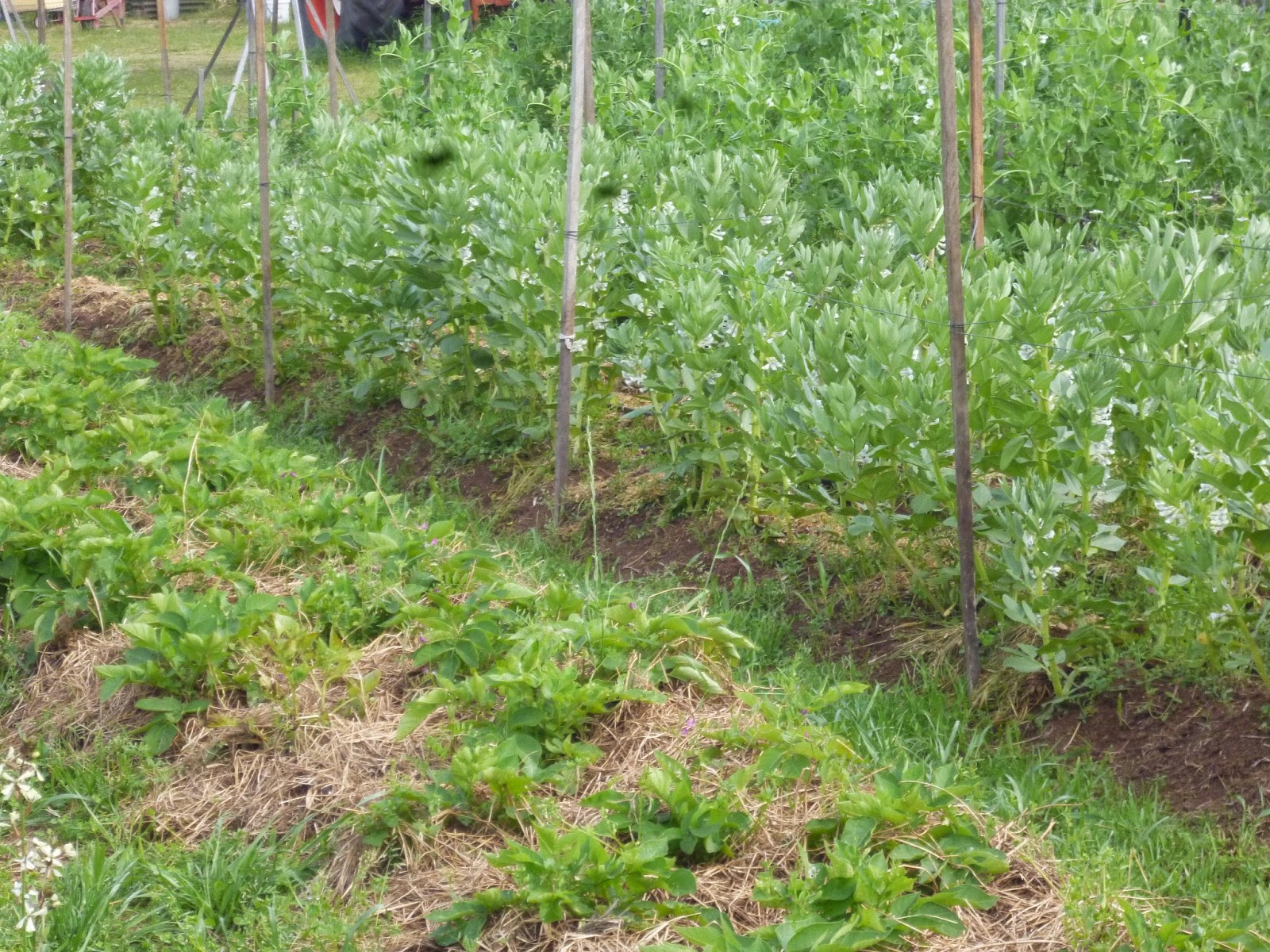
Potatoes and leeks mounded in a circular bed which is part of the chook tractor rotation.
Logan berries leafing up and bursting into flower. We had such a poor harvest last year due to the dry spring, but things are looking much better this year after a more gentle wet start to spring.
More potatoes in a bed outside the mandalas which have been cultivated by the pigs.
Guinea pigs mowing the grass between our long beds. Mark calls them his solar powered lawn mowers. They do such a great job and give us manure for our compost heap. If you're looking for another source of manure to add diversity to your compost heap, and you live in an urban situation, you can't go past guinea pigs. This is especially true if you have children. They make great pets. I've had some really rowdy boys at some of our parties and farm tours, who are settled by cuddling a guinea pig. They will sit for around 20mins or so with a guinea pig on their laps, not moving an inch. They are much more settled and move on to some more constructive play afterward. Of course they do need supervising when they are very young. We have some available for sale if anyone's looking for one as a Christmas present.
Rows and rows of peas and broadbeans. We grow snowpeas and shelling peas.We have started netting the stone fruit for fruit fly.
More potatoes alongside the broadbeans.
We are preparing beds for all our summer crops and they will go in in the next week or so. They have to as we are off to Italy in less than two weeks. We have one last Mums and Bubs tour (fully booked) and another farm tour left before we go. If you would like to see our Biodynamic, Permaculture garden in all it's spring bounty, we still have places available.
Monday, September 29, 2014
Spring Bounty
These are exciting times at PPF
Kate has found the time and the inspiration to bring you an update on happenings here on the farm.

I know! It's been a long long time. I find it increasingly difficult to divide my time between the real world and this virtual world, but I do find myself missing it. I have also found that others are missing my posts, so I've promised to be a little more regular, even if it's just some photos with very little words.
We are harvesting some really lovely produce at the moment and the CSA boxes are looking beautiful as can be seen in the photo above. Spring can sometimes be a little difficult because of the in between of the Winter vegies and the yet to grow summer bounty, but because of the spring rain and some forward planning we have an abundance.
For this week's box my weekly menu looks like this...
Monday Pasta with Cauliflower sauce
Tuesday Stir fry
Wednesday Rice and Vegetable Pie with Beetroot salad
Thursday Palak Paneer
Friday Pizza
Saturday Vegetable Curry
Sunday Roast
After checking the pantry, all I need to buy is some rice noodles to go with the stirfry.
Menu planning is important when eating seasonally, especially if you get a weekly box of farm fresh seasonal produce. This reduces any chance of food going to waste.
If you live in our area and are interested in getting one of our weekly boxes, send me an email and I'll discuss it with you.
Here's hoping I can manage my time better to share more of what's going on for us . As Mark said, we are in extremely exciting times here on the farm!!!
Kate has found the time and the inspiration to bring you an update on happenings here on the farm.
I know! It's been a long long time. I find it increasingly difficult to divide my time between the real world and this virtual world, but I do find myself missing it. I have also found that others are missing my posts, so I've promised to be a little more regular, even if it's just some photos with very little words.
We are harvesting some really lovely produce at the moment and the CSA boxes are looking beautiful as can be seen in the photo above. Spring can sometimes be a little difficult because of the in between of the Winter vegies and the yet to grow summer bounty, but because of the spring rain and some forward planning we have an abundance.
For this week's box my weekly menu looks like this...
Monday Pasta with Cauliflower sauce
Tuesday Stir fry
Wednesday Rice and Vegetable Pie with Beetroot salad
Thursday Palak Paneer
Friday Pizza
Saturday Vegetable Curry
Sunday Roast
After checking the pantry, all I need to buy is some rice noodles to go with the stirfry.
Menu planning is important when eating seasonally, especially if you get a weekly box of farm fresh seasonal produce. This reduces any chance of food going to waste.
If you live in our area and are interested in getting one of our weekly boxes, send me an email and I'll discuss it with you.
Here's hoping I can manage my time better to share more of what's going on for us . As Mark said, we are in extremely exciting times here on the farm!!!
Monday, July 28, 2014
Fresh Food Gardens in Arid Australia.
A couple of weeks back, Mark was sent out to an indigenous community near Alice Springs. He left me in charge of the farm for two weeks and set off on his adventure. Following is his account of the project.
.JPG)
I was privileged to be asked by Slow Foods Hunter Valley to look at fresh food in Central Australia. I spent two weeks near Kings Canyon on a community project for a food garden. The project for me centered around a market garden set up in
the Wanmara community by a group keen to get food available in the Kings Canyon
area. The well (over) resourced enterprise was way too much for the members of
the community and it was important that we provide a manageable food growing
opportunity for the community that could be expanded into the future if that
was what they wanted.
We needed to reduce the need for labour if possible and make
the garden a place where the community would be interested in and keen to
attend on a regular (daily) basis. The conventional market garden was seen as
uninspiring.
In consultation with the key people in the community, Peter,
Christine and Elma, we designed a garden along the lines of a mandala garden
with the idea that chickens in purpose built domes could do the bulk of the
work in cultivating, fertilizing, insect
control and bed clean up and weed control.

We added to this a meandering garden
where some of the bush tucker of the area could be grown.
The mandala incorporates the existing propagation house and
a small citrus orchard in a position close to the houses with room for
expansion as interest grows. The
introduction of chickens will need to wait till they can be provided with
electric mesh fencing to keep out dingos and the construction of the
appropriate housing.
We constructed compost piles using local pest “Buffel” grass
and camel and donkey manure from Kings Creek Station nearby.
.JPG)
.JPG)
.JPG)
.JPG)
.JPG) |
| Mulga sticks used to build the compost enclosure |
We also propagated
a range of seasonal vegetables for planting in the mandala garden and some bush
tucker plants as well.
.JPG)
.JPG)
We arranged stones to outline the beds and paths
.JPG)
and
constructed a couple of ponds to invite the wildlife to be part of the solution
to the arid environment and invite biological pest controllers to the
garden.

.JPG)
All mandalas were fitted with
drip irrigation from the previous garden.
.JPG)
The bush foods garden is an ongoing, evolving project with the plan a start to making it happen.

Though we have made a great start there remains plenty to do
to ensure we have a workable, interesting and productive fresh food garden for
the communities inhabitants, and perhaps the wider community in the arid centre
of Australia.


Subscribe to:
Posts (Atom)